

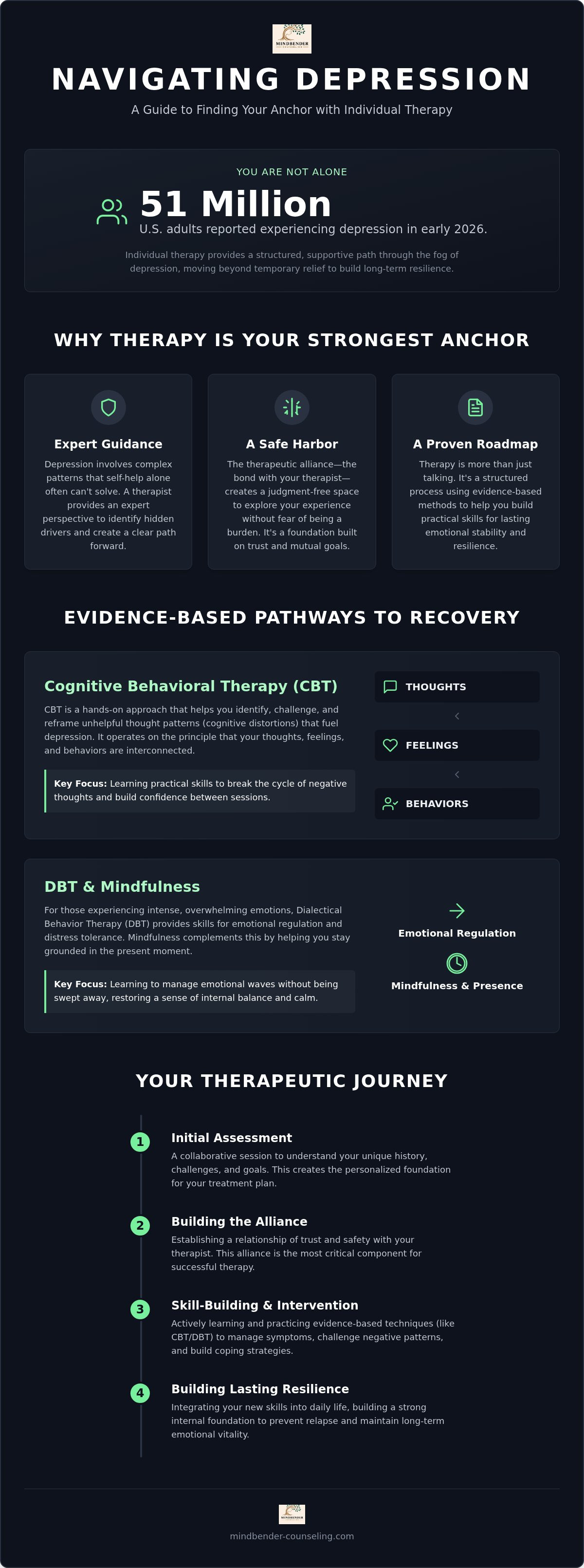
In the first few months of 2026, over 51 million adults in the United States reported navigating the heavy weight of depression. If you feel like you're carrying an invisible burden that drains your motivation and clouds your thoughts, you're certainly not alone in that experience. It's exhausting to wake up every day feeling stuck in a cycle of negative thoughts, especially when you're considering individual therapy for depression but worry that the process might feel cold or impersonal. You deserve a space where you're treated as a whole person rather than just another clinical case.
We understand that the path to healing requires both professional expertise and genuine empathy. This guide explores how personalized, evidence-based care offers more than just a place to vent. It provides a structured roadmap to help you reclaim your emotional vitality and build a resilient foundation for the future. You'll discover the specific therapeutic methods that lead to lasting change, experience the relief of feeling truly seen by a professional, and learn actionable steps to improve your daily mental health starting today.
Key Takeaways
- Learn how individual therapy for depression moves beyond simple conversation to provide a research-backed framework for long-term emotional stability.
- Understand how a personalized treatment plan respects your unique history and personality to create a clear, supportive path forward.
- Gain clarity on the typical progression of a therapeutic journey so you can approach your sessions with confidence and a sense of control.
- Discover the benefits of evidence-based methods that provide a steady anchor as you work toward reclaiming your daily motivation and vitality.
Beyond the Fog: Why Individual Therapy for Depression is Essential
Depression often feels like a thick, grey fog that separates you from the life you once enjoyed. It isn't just a temporary mood; it's a persistent state that affects your physical body, your internal thoughts, and your hope for the future. While clinical journals define it by a list of symptoms, we recognize it feels like a profound loss of self. Effective psychotherapy for depression addresses this by creating a collaborative, one-on-one process focused on both immediate relief and long-term resilience. This structured approach helps you dismantle the heavy cycles that keep you stuck.
It's common to try to "think your way out" or rely exclusively on self-help strategies. While these tools have their place, they often fall short because depression involves complex neurochemical and behavioral patterns that are difficult to interrupt without professional help. Individual therapy for depression provides the external perspective and expertise needed to identify these hidden drivers. It moves you beyond the surface, allowing you to build a foundation that supports your emotional growth and stability.
Recognizing the Unique Weight of Depression
Depression doesn't look the same for everyone. For some, it manifests as an overwhelming fatigue that makes small tasks feel like marathons. For others, it's a sharp, constant irritability or a total loss of interest in life's pleasures. Distinguishing between temporary grief, occupational burnout, and clinical depression requires professional insight. A licensed therapist helps you understand your specific experience so you can apply the right tools for your recovery. Individual therapy for depression remains the gold standard for personalized mental health recovery.
The Role of a One-on-One Therapeutic Alliance
The foundation of your progress is the therapeutic alliance. This is the unique bond you share with your therapist, built on trust and mutual goals. Unlike talking to friends or family, a private session offers a safe, judgment-free space where you can explore your experience without fear of being a burden. Your therapist acts as a sturdy anchor, providing stability when your emotions feel turbulent. This one-on-one environment allows for a level of personalized evolution that group settings or self-guided apps simply cannot replicate.
Evidence-Based Pathways to Recovery
When you begin individual therapy for depression, you aren't just looking for a sympathetic ear. You're looking for methods that actually work. Evidence-based therapy refers to psychological treatments that have been rigorously tested through scientific research to prove their effectiveness. At Mindbender Counseling, we utilize these research-backed tools to ensure your time in sessions leads to measurable progress. According to the NIMH on depression treatment, these structured approaches are vital for achieving remission and building a solid internal foundation.
There's a common myth that therapy is simply "venting" or talking about your week. While sharing your feelings is important, individual therapy for depression is far more structured. It involves active behavioral health interventions designed to rewire how you process challenges. By learning these specific skills, you don't just feel better temporarily; you build a toolkit that helps prevent future relapses. This methodical approach provides the calm assurance you need to move forward with confidence.
Cognitive Behavioral Therapy (CBT): Reframing the Narrative
CBT operates on the principle that your thoughts, feelings, and behaviors are deeply interconnected. When you're depressed, your mind often falls into "cognitive distortions," which are unhelpful thought patterns like "everything is my fault" or "nothing will ever change," that fuel feelings of hopelessness. In a session, you won't just discuss these thoughts. You'll actively map out how one negative assumption leads to a day of isolation. CBT provides practical homework to build your confidence between sessions, ensuring you can handle a difficult afternoon just as well as you handle an hour in the office.
Dialectical Behavior Therapy (DBT) and Mindfulness
If your emotions feel like a tidal wave, DBT offers a way to find your footing. It focuses on emotional regulation and distress tolerance, teaching you how to manage intense feelings without becoming overwhelmed. Mindfulness-based techniques complement this by helping you stay grounded in the present moment rather than being pulled into the past or future. You can learn more about these approaches in our Mindbender guide on behavioral therapy. These methods act as a catalyst for movement, helping you restore balance to your daily life.
Finding the right approach is a personal journey that requires expert guidance. If you're ready to move toward a more stable future, our team offers Individual Counseling Services designed to support your unique evolution.
Personalizing Your Depression Treatment Plan
Recovery isn't a linear path found in a standard manual. It's a custom-built bridge designed for your specific life. When you begin individual therapy for depression, the first step involves a deep, compassionate understanding of your world. Your therapist looks at your history, your personality, and the unique stressors currently weighing you down. This isn't just a clinical intake; it's the start of a partnership. As noted by the Mayo Clinic, comprehensive depression treatment often requires this level of detail to ensure the interventions align with your biological and emotional needs.
A personalized roadmap provides clarity in the middle of the fog. By identifying which aspects of your life are most impacted, we can prioritize the tools that will bring you the most immediate relief. This process respects your individuality and acknowledges that your experience of depression is as unique as your fingerprint. We believe that when therapy is tailored to your specific needs, the path to reclaiming your vitality becomes much clearer and more manageable.
Moving Beyond a One-Size-Fits-All Approach
A generic individual therapy program might offer standard coping skills, but a personalized plan adapts to how you actually live. Some days you might need a directive approach with clear, actionable steps to get through a difficult week. Other days require a reflective space to process complex emotions or past wounds. Therapists adapt their style, ranging from directive to reflective, based on your needs. Your specific goals drive the treatment. Whether you're focused on returning to a demanding career or simply wanting to feel present with your family again, the strategy remains flexible. We adjust the pace to your comfort level, ensuring you always feel supported but never pressured.
Integrating Lifestyle and Emotional Resilience
True healing looks at the whole person rather than just a set of symptoms. We help you rebuild your daily rhythm by examining how sleep, nutrition, and social connections influence your mood. One powerful tool in individual therapy for depression is behavioral activation. This method helps break the cycle of depression-induced lethargy by gently reintroducing activities that provide a sense of accomplishment or joy. By addressing these practical lifestyle factors alongside emotional work, you build a solid internal foundation. This integrated approach ensures that the stability you find becomes a permanent part of your life's architecture.
What to Expect in Your Individual Therapy Journey
Starting a new path often brings a mix of hope and apprehension. It's natural to feel uncertain about what happens behind the closed door of a professional session. By understanding the steady, methodical progression of individual therapy for depression, you can lower your defenses and focus on your recovery. You're always in control of the pace and the topics we discuss. This journey isn't something that happens to you; it's a collaborative process where you're the primary architect of your own internal balance.
Many people worry about "getting it right" or not knowing where to start. We don't express any expectation for you to have all the answers or even a clear list of symptoms during your first visit. Our licensed professionals in Arizona and Texas provide a calm, structured environment where you can slowly unpack your experiences at your own speed. Over time, the focus naturally shifts from managing immediate emotional crises to building a life centered on long-term growth and personal evolution.
The Initial Assessment: Mapping Your Goals
The first one or two sessions serve as an information-gathering phase. This is a time for us to build a foundation of trust and safety. If you find it difficult to articulate your goals because you "just feel bad," don't worry. We'll help you find the words and identify the specific areas where you want to see improvement. This initial period is also an opportunity for you to see if your therapist is the right fit for your personality. A strong connection is essential for successful outcomes, and we encourage you to listen to your intuition during these early conversations.
Navigating the Middle Phase: Doing the Work
Once we've established a roadmap, we enter the middle phase of therapy. This is where active skill-building and processing take place. During this stage of individual therapy for depression, you'll begin to apply the evidence-based tools we've discussed to your daily life. It's common to encounter setbacks or days when the fog feels thicker again. We'll help you navigate these moments without losing sight of the progress you've already made. Consistency is key. Showing up even on your "bad" days is often when the most profound breakthroughs happen, as it allows us to work through challenges in real-time.
If you're ready to begin this transformative process, we invite you to explore our Individual Counseling Services and take the first step toward reclaiming your emotional vitality.
Finding Your Anchor: Individual Therapy at Mindbender Counseling
Mindbender Counseling serves as a specialized provider for those seeking individual therapy for depression in Arizona and Texas. We believe that professional support should feel like a partnership rather than a cold, clinical transaction. Our approach blends deep clinical expertise with a warm, supportive atmosphere, ensuring you feel seen as a whole person rather than just a diagnosis. This combination of authoritative resource and empathetic partner allows us to build immediate trust. By choosing this path, you're making a meaningful investment in your future self and the long-term quality of your emotional life. We treat every individual with fresh attention and care, rooted in the calm assurance that positive change is possible.
Compassionate Care for Arizona and Texas Residents
We focus specifically on serving professionals and individuals across the Southwest who face unique regional stressors. Our local expertise allows us to understand the cultural nuances and lifestyle patterns of Arizona and Texas, providing a level of care that feels relevant and grounded. Whether you're navigating the fast-paced professional environments of Phoenix and Dallas or the specific community dynamics of smaller towns, we provide a steady anchor. For those who may feel hesitant about seeking help, our guide on private therapy offers insights for anyone concerned about discretion and privacy. We prioritize your comfort and confidentiality at every stage of the process, ensuring that your journey toward health remains a safe and private evolution.
Taking the First Step Toward Healing
Our scheduling process is designed to be low-friction and straightforward because we know that reaching out can feel like the hardest part when your motivation is low. You don't need to have everything figured out before you schedule your first session. Our role is to act as a professional facilitator for your journey toward well-being, helping you build the resilience needed to reclaim your emotional vitality. Individual therapy for depression is a catalyst for movement, transforming your current exhaustion into a roadmap for lasting stability. Taking a small, brave step today sets the foundation for a better 2026. You deserve to feel supported by a guide who possesses deep experience and genuine care. You do not have to carry the weight of depression alone.
Reclaiming Your Emotional Vitality and Balance
Navigating the heavy weight of depression is a deeply personal experience, but you don't have to find your way out alone. We've explored how individual therapy for depression transforms the feeling of being stuck into a clear, structured roadmap for recovery. By utilizing evidence-based tools, you can build a solid internal foundation that supports long-term resilience and emotional stability. You now understand that therapy isn't just about conversation; it's about active, personalized skill-building that respects your unique pace and history.
At Mindbender Counseling, our licensed therapists in Arizona and Texas provide the expert guidance and compassionate care you need to move forward with confidence. We invite you to view this process as a vital investment in your future self. When you're ready to take a brave step toward a more balanced life, we're here to act as your sturdy anchor. Schedule your personalized individual therapy session with Mindbender Counseling today. You possess the strength to reclaim your joy, and we're honored to support your evolution toward lasting well-being.
Frequently Asked Questions
How do I know if I need individual therapy for depression or if I am just sad?
Sadness is a temporary reaction to a specific event, while depression is a persistent state that affects your daily functioning. If you've felt a loss of interest in activities or a lack of motivation for more than two weeks, individual therapy for depression can help you distinguish between transient emotions and clinical conditions. A professional assessment looks at the severity and duration of your symptoms to provide a clear path forward for your recovery.
How long does it usually take to see progress in depression therapy?
Most people begin to feel a sense of relief after the first few sessions, though long-term progress typically takes several months of consistent work. The timeline for healing is unique to every individual. While initial symptom relief might happen quickly as you learn immediate coping skills, deep behavioral change and emotional resilience require a steady, methodical approach. We focus on sustainable growth rather than quick fixes to ensure you reclaim your emotional vitality permanently.
Will I have to talk about my childhood in every individual therapy session?
You are not required to discuss your childhood in every session, as our focus remains on your current well-being and future goals. While your past experiences certainly shape who you are today, therapy at Mindbender Counseling is often future-oriented. We prioritize the evidence-based tools and strategies that help you manage your daily life right now. We only explore the past when it provides necessary context for breaking a current cycle of negative thoughts or behaviors.
Is individual therapy for depression covered by insurance in Arizona and Texas?
Many major insurance plans cover mental health services, although specific coverage varies by provider and plan. We recommend contacting your insurance carrier directly to verify your benefits and any potential copays. For residents in Arizona and Texas, checking your status is a helpful first step. Our team can provide the necessary documentation to assist you in navigating your benefits and reducing the friction of seeking professional support during your recovery journey.
What is the difference between individual therapy and talking to a supportive friend?
The primary difference lies in the professional expertise, objective perspective, and evidence-based techniques a licensed therapist provides. While a supportive friend offers emotional warmth, a therapist acts as a sturdy anchor and a skilled guide. Individual therapy for depression involves structured interventions designed to rewire unhelpful thought patterns. It's a judgment-free space where the focus is entirely on your personal evolution, without the social reciprocity or potential biases often found in personal friendships.
Can I do individual therapy if I am already taking antidepressant medication?
Yes, you can absolutely participate in individual therapy while taking antidepressant medication. Research often shows that a combination of therapy and medication is highly effective for many individuals. While Mindbender Counseling does not provide psychiatric medication management, we work alongside your prescribing physician to ensure your care is integrated. Therapy provides the behavioral tools and emotional skills that medication alone cannot offer, helping you build a solid internal foundation and long-term resilience for the future.
What happens if I do not feel a connection with my therapist after the first session?
It's perfectly normal to occasionally feel that a therapist isn't the right fit, and we encourage you to prioritize your comfort. A strong therapeutic alliance is the foundation for all successful outcomes. If you don't feel a sense of safety or understanding after your first session, we can help you transition to another professional within our team. Your healing journey is the priority, and finding a guide who resonates with your personality is essential for lasting progress.
How do I prepare for my first individual therapy session at Mindbender Counseling?
Preparing for your first session is as simple as coming with an open mind and a willingness to be honest about your current struggles. You don't need a formal list of symptoms or a prepared speech. Many clients find it helpful to think about one or two specific goals they hope to achieve, such as improving sleep. We make the process low-friction by handling the clinical details so you can focus on your emotional growth.


